
The C-Myc (EQKLISEEDL)-FITC Antibody is a premium polyclonal antibody conjugated with fluorescein isothiocyanate (FITC), designed to specifically detect the C-Myc epitope tag. Widely used in molecular biology, the C-Myc tag facilitates the detection, purification, and localization of recombinant proteins. The FITC conjugation enables direct fluorescent detection, making it ideal for a variety of applications including flow cytometry, immunofluorescence, and confocal microscopy.
This antibody is optimized for reliable detection of C-Myc-tagged proteins in a range of expression systems and is suitable for high-sensitivity studies in both basic and applied research.
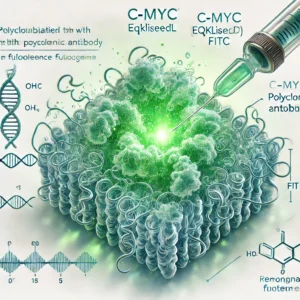
Key Features
- Epitope Targeting: Recognizes the highly specific EQKLISEEDL sequence of the C-Myc tag.
- Fluorescent Labeling: Conjugated with FITC, a bright and photostable fluorophore with excitation/emission maxima at 495/519 nm, producing sharp green fluorescence.
- Polyclonal Design: Detects multiple epitopes, enhancing sensitivity and reducing false negatives.
- Versatile Applications: Compatible with immunofluorescence (IF), flow cytometry (FC), confocal microscopy, and immunoprecipitation (IP).
- Cross-Species Compatibility: Reacts with C-Myc-tagged proteins across human, mouse, bacterial, and yeast systems.
Specifications
| Attribute | Details |
|---|---|
| Host Species | Rabbit |
| Isotype | IgG |
| Conjugate | FITC (Fluorescein Isothiocyanate) |
| Epitope Recognized | C-Myc Tag Sequence (EQKLISEEDL) |
| Concentration | 0.1 mg/mL |
| Applications | IF, FC, IP, Confocal Microscopy |
| Storage Conditions | Store at 4°C in the dark |
| Formulation | PBS, pH 7.4, with 0.09% sodium azide and 50% glycerol |
Applications
1. Immunofluorescence (IF)
- Objective: Detect C-Myc-tagged proteins within fixed cells or tissues.
- Protocol:
- Fix samples in 4% paraformaldehyde for 10-15 minutes.
- Permeabilize with 0.1% Triton X-100 for 10 minutes.
- Block nonspecific binding with 5% BSA or serum for 30 minutes.
- Incubate with the C-Myc-FITC Antibody (1:100 dilution) for 1 hour at room temperature.
- Wash, counterstain with DAPI for nuclei, and mount for imaging.
2. Flow Cytometry (FC)
- Objective: Quantify expression of C-Myc-tagged proteins in cell populations.
- Protocol:
- Prepare single-cell suspensions and fix cells using a flow-compatible buffer.
- Incubate with the antibody (1:50 dilution) for 30 minutes on ice.
- Wash and analyze on a flow cytometer equipped with a 488 nm laser.
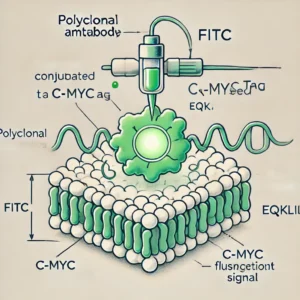
3. Confocal Microscopy
- Objective: High-resolution visualization of C-Myc-tagged protein localization within cells.
- Protocol:
- Use the immunofluorescence protocol, and ensure optimal imaging settings for FITC fluorescence.
4. Immunoprecipitation (IP)
- Objective: Enrich C-Myc-tagged proteins for functional or structural analysis.
- Protocol:
- Add antibody to lysates containing C-Myc-tagged proteins and incubate overnight at 4°C.
- Add protein A/G beads to capture the immune complex.
- Wash beads to remove nonspecific proteins, then elute bound protein for analysis.
5. Western Blot Validation
- Objective: Confirm C-Myc expression using fluorescence instead of HRP.
- Protocol:
- Run SDS-PAGE and transfer to a PVDF membrane.
- Use the FITC-antibody directly for fluorescence-based detection.
Research Applications
- Protein Expression Studies: Track recombinant protein expression and localization.
- Drug Screening: Quantify the effects of small molecules on tagged proteins.
- Molecular Interaction Assays: Investigate protein-protein or protein-DNA interactions.
- Cell Biology: Visualize and quantify subcellular localization and trafficking of tagged proteins.
- High-Throughput Screening: Ideal for assays requiring rapid fluorescence detection.
Advantages
- Direct Detection: No need for secondary antibodies, reducing assay time.
- Bright Fluorescence: FITC provides excellent signal strength and photostability.
- Wide Compatibility: Suitable for use with various recombinant protein systems.
- Cost-Effective: Saves time and resources in fluorescent labeling and detection.
Storage and Handling
- Storage: Store at 4°C in the dark to prevent photobleaching.
- Stability: Stable for 6 months when stored properly. For long-term use, aliquot and avoid freeze-thaw cycles.

Safety Information
- Contains sodium azide as a preservative. Use personal protective equipment when handling and dispose of waste properly.
References
- PubMed: C-Myc Research Articles
- KEGG Pathways: C-Myc Signaling Pathways
- NIH: Protein Expression Resources
- Addgene: C-Myc Plasmids and Tools